
Creating a niche for yourself in marketing can be a successful strategy by focusing your work on a particular group of people or interests. However, there are occasions where that niche becomes too limiting, and you have to open up and develop a larger space for yourself.
For the last few years I have written this blog that initially sought to cater to Vocational Rehabilitation Counselors. When I started the blog, I was in graduate school and looking for new ways to enhance my work using technology, and a blog appeared to be a good option. The idea was to provide information and resources to VR counselors regarding disability and rehabilitation as well as provide as sense of community for these diverse professionals. (Visit the Inaugural Post for the details.)
While valuable, the scope of MaineVRC has become too restrictive, and limited. I am launching a new site and will no longer be updating this space. Thank you for your participation and readership.
Please join me at my new site JoshuaHowe.com
Friday, February 4, 2011
Saying Goodbye to a Niche

Sunday, December 19, 2010
iPhone and Android app which adjusts for Color blindness
DanKam is a $3 iPhone and Android app which allows the user to adjust for their colorblindness.
Though not colorblind himself, Dan Kamisky designed the app, and gives a great run down on it on his blog, aptly named Dan Kamisky's Blog.
He excerpts some of the reviews from the app stores, and they're understandably positive,
"As a colorblind person I just downloaded this app. How can I f*cking nominate you to the Nobel Prize committee? I am literally, almost in tears writing this, I CAN FRICKIN’ SEE PROPER COLORS!!!! PLEASE KEEP UP THIS WORK! AND CONTINUE TO REFINE THIS APP!
–Aaron Smith"
This is why I love the web and technology. This is a perfect example of a great idea which would improve the lives of thousands of people. Because of technology and the web, he was able to bring it to fruition and get out at a reasonable cost for people to access. And as it's a mobile phone application, it also allows people to use it where they live and function, rather than being tied to a desktop.
Dan Kamisky's Blog
DanKam; Augmented Reality for Color Blindness
Thanks for supporting Maine VRC.
Thursday, December 2, 2010
Temple Grandin on Autism at the TED Conference
Temple Grandin at the TED conference talking about how "The World Needs All Kinds of Minds"
Thanks for supporting Maine VRC.
Friday, September 10, 2010
Special Olympics Athlete First video
Here's a beautifully done video for Special Olympics.
SPECIAL OLYMPICS from MTC CORP on Vimeo.
Thanks for supporting Maine VRC.
Wednesday, September 8, 2010
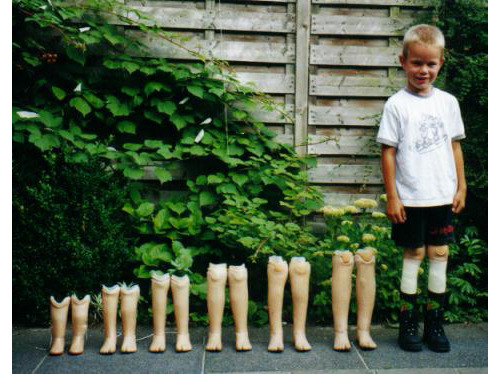
Prosthesis through the years
Great image of a young boy with multiple sets of prosthesis and how they've grown with him.
Monday, June 7, 2010
Eric Idle is a Greedy Bastard (it says so in his diary)
This has nothing to do with disability. I love Monty Python and Eric Idle, so enjoy this short piece about his book "The Greedy Bastard Diary"
Thanks for supporting Maine VRC.
Friday, May 7, 2010
Howie Mandel's OCD and book "Don't Touch Me"
Short piece about Howie Mandel's experience with OCD (Obsessive Compulsive Disorder).
Thanks for supporting Maine VRC.